Stefany Palomba Learning Design

Pedagogy First.Technology Second.Thinking Always.

Start with the learner and the learning goal. Use strong pedagogy and evidence to design the response. Then decide where technology belongs.

Stefany Palomba, M.Ed. • Educator, learning designer, and professional learning leader working alongside teachers, students, families, coaches, and school leaders.

What Comes First

  1. The goalStudent Success
  2. The foundationStrong Pedagogy
  3. The designResponsive Learning Design
  4. The supportAppropriate Technology
Start With the Problem

Where is learning getting stuck?

Most schools do not have an AI problem. They have a learning-design problem that technology keeps getting invited into. See which of these sounds like your classroom, your child, or your building.

In the classroom

Teachers
  • Differentiation takes too long.
  • Students need different levels of support.
  • I keep recreating lessons and materials from scratch.
  • Students are using AI, but expectations are unclear.
  • My assessment may no longer measure what I think it measures.
  • I want AI to save time without lowering rigor.
  • Students need support without losing ownership of the learning.
  • We have tools, but I am not sure which ones actually belong in my instruction.

At the kitchen table

Students & Families
  • How can AI help with studying without doing the learning?
  • How can students organize assignments, deadlines, and study time?
  • Can AI explain difficult concepts responsibly?
  • What counts as acceptable AI use?
  • How can students prepare for college and careers where AI will be part of the environment?

Across the building

Leaders
  • Where should AI fit into our curriculum?
  • What should our policies actually say?
  • How do we create consistent expectations across classrooms?
  • How should assessment change?
  • How do we support teachers with different levels of AI experience?
  • How do we protect student thinking and academic integrity?
  • How do we move beyond random tools and create a thoughtful instructional plan?

These are not technology problems alone. They are learning-design problems.

Featured Newsletter

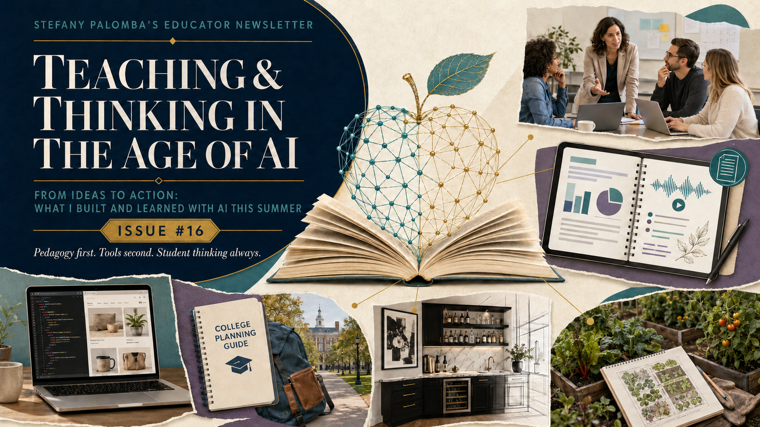
Teaching & Thinking in the Age of AI

Research, classroom practice, learning design, and the questions educators should be asking as AI becomes part of teaching and learning.

Teaching and Thinking in the Age of AI newsletter cover
Three Ways In

Find the right starting point.

Every conversation begins with the same question—what are students supposed to learn, and what is getting in the way? Where it goes next depends on who is asking.

For Teachers

Teach Smarter With AI

“I am rebuilding materials from scratch, and differentiation eats the hours I do not have.”

  • Lesson and unit design, standards alignment, and rigor
  • Differentiation, scaffolds, study guides, slides, and resources
  • Assessments, rubrics, and feedback that still measure thinking
  • Reusable planning workflows, Google Gems, and custom AI assistants
  • Classroom AI expectations that protect student thinking

Teach what matters. Use AI where it helps. Keep student success at the center.

For Students & Families

Study Smarter With AI

“We want AI to support studying—without quietly doing the learning for us.”

  • Study systems, organization, and time management
  • Study schedules, practice questions, and useful feedback
  • Research support and college preparation
  • Responsible AI use and academic integrity
  • Study guides students actually return to

AI can support the learner. It should not replace the learning.

For Administrators, Schools & Districts

Lead With AI

“We have tools in the building, but no shared instructional approach behind them.”

  • Curriculum review, standards alignment, and AI readiness
  • Policy, classroom expectations, and transparency
  • Academic integrity and assessment redesign
  • Professional learning for varied levels of AI experience
  • Implementation planning and ongoing teacher support

Schools need more than disconnected AI tools. They need a thoughtful instructional approach that keeps student success at the center.

How It Works

How we work through the problem.

No tool demos to sit through. We look at the actual work in front of you and decide together what the learning needs.

1

Bring the Challenge

Lesson, unit, assessment, curriculum concern, student need, policy question, workflow, or instructional problem.

2

Look at the Learning

Examine the standards, goals, evidence, learners, instructional demands, and the thinking students need to do.

3

Decide What Belongs

Determine what should be redesigned, differentiated, streamlined, supported with AI, or intentionally left without AI.

The decision is instructional first, technical second. — sometimes the best answer is “keep it exactly as it is”
The important question is not simply what AI can do, but how educators can use it to design instruction that supports learning for all students.

AI can help educators design stronger lessons, respond to learner needs more quickly, differentiate instruction, and create meaningful supports—while keeping student success at the center.

About

About Stefany Palomba

Portrait of Stefany Palomba
Stefany Palomba, M.Ed.
Educator & Learning Designer

Stefany Palomba is an educator, learning designer, and professional learning leader with nearly three decades of experience in teaching, curriculum, instructional leadership, and educator development.

Her work focuses on helping educators use emerging technologies intentionally to strengthen instruction, differentiate learning, improve teacher efficiency, and support student success.

Rather than beginning with an AI platform, Stefany begins with the curriculum: the standards students are expected to master, the learning goals teachers are working toward, the evidence available about student understanding, and the barriers that may be preventing students from accessing the content.

From there, she works alongside educators to determine where AI can meaningfully support lesson design, differentiation, assessment, feedback, instructional materials, planning, and student learning—and where traditional instructional approaches remain the better choice.

Her professional work has included graduate-level instruction, district professional development, national and regional conference presentations, podcast conversations, and ongoing study and application of emerging AI tools in education. Stefany has presented nationally on AI-supported differentiation and the development of classroom AI policies and guidelines, and regionally on standards-based learning and instructional design with AI.

Her work with platforms including Google Gemini, Google Gems, NotebookLM, Claude for Education, ChatGPT, MagicSchool AI, SchoolAI, Canva, Diffit, and other emerging tools supports a broader purpose: helping educators design instruction that is responsive to students, grounded in sound pedagogy, and practical enough to use in real classrooms.

The principlePedagogy First. Technology Second. Thinking Always.
The goalStudent Success.
“I am not observing this transformation from outside the classroom. I am navigating it alongside teachers.”
Stefany Palomba
Experience & Expertise

Nearly 30 years in education. Always learning. Always connected to the classroom.

Stefany Palomba brings together decades of educational experience, research-informed instructional practice, curriculum knowledge, professional learning, and hands-on work with emerging AI to help solve real problems in teaching and learning.

Nearly 30 Years in Education

Classroom teaching, curriculum, instructional leadership, mentoring, and professional learning provide the foundation for this work.

Research-Informed Learning Design

Instructional decisions are grounded in student engagement, differentiation, standards alignment, assessment, learning science, and evidence-informed practice.

National & Regional Experience

National presentations on differentiation with AI and classroom AI policies and guidelines; regional presentations on standards-based learning design; and podcast conversations focused on AI and education.

Professional Learning & Graduate Instruction

Experience designing professional development and teaching educators through graduate-level instruction, connecting research and pedagogy to real classroom application.

AI-Informed Instructional Design

Ongoing study and application of emerging AI platforms through a pedagogy-first lens, with attention to where technology strengthens instruction and where student thinking must remain independent.

Experience matters most when it can be applied to the problem in front of you. Experience becomes valuable when it helps solve the problem in front of the teacher, learner, or school.

Experience+Evidence+Curriculum Knowledge+Learning Design+Appropriate Technology

Together, these help educators make stronger instructional decisions more efficiently—so the time saved goes back into students.

Instructional Responsiveness

Better tools for better instructional decisions.

Effective learning design is not simply about making instruction more engaging. It is about improving what actually moves learning forward.

What learning design improves

Access to contentMeaningful practiceFeedbackDifferentiationUnderstandingRetentionStandards alignmentAssessmentAcademic performance

Where AI can speed the adjustment

Adjusted reading levelsAlternate explanationsTargeted practiceAdditional examplesResponses to misconceptionsFormative assessmentsModified pacingStandards-aligned review materialsStudy supportsPersonalized scaffoldsDifferentiated resources

When teachers can respond more quickly to learner needs, differentiate materials, provide targeted practice, and align instruction closely to standards and assessment evidence, students have stronger opportunities to improve understanding and academic performance. AI can make that instructional responsiveness more efficient.

AI does not improve learning by itself. Strong instructional decisions do. AI can help educators make those adjustments faster.

Bring Your Curriculum

Practical Outcomes

What we can build together.

Sessions end with something usable—work that still sounds like your classroom, your curriculum, and your students.

Lesson plans
Unit frameworks
Study guides
Assessments
Rubrics
Slides
Differentiated resources
Standards-aligned materials
Google Gems
Teacher workflows
Classroom AI guidelines
Study systems
Curriculum maps
Planning systems
Feedback tools
Tools That Support the Work

The tool is the last decision, not the first.

The value is not knowing more tools. The value is knowing which tool—or whether any tool—belongs in the learning process.

Gemini Google Gems NotebookLM Claude for Education ChatGPT MagicSchool AI SchoolAI Canva Diffit and other emerging educational AI platforms

The goal is not to collect more tools. It is to build better instructional systems.

What Educators Are Saying

Real educators. Real instructional problems.

Practical solutions they could use immediately.

“I had been searching for a better way to communicate with parents, students, and coaches without spending hours managing schedules, messages, and phone calls. During Stefany’s workshop, I was able to build a website that became a working hub for communication, scheduling, planning, and resources. What started as an idea became a system I could actually use—and it has saved me hours of work.”

DanGraduate Education Participant / Athletic Administrator

“In just a few hours, Stefany helped me take a month of instruction and turn it into an organized classroom plan with lessons, resources, supports, and materials I could actually use. Creating everything on my own would have taken weeks—possibly months. The biggest difference was that the work still felt like my classroom and my teaching, just more organized and manageable.”

SarahMiddle School Science Teacher

“Stefany didn’t begin by teaching an AI tool. She began with what I needed my students to learn. From there, we redesigned lessons and materials for the students actually sitting in my classroom—including English learners, students with IEPs, students with ADHD, and students who needed additional challenge. AI became part of the solution, but the learning goal always stayed at the center.”

Classroom EducatorK–12 Teacher

Learning Alongside Educators

During the 2026–27 school year, Stefany’s home district is implementing aiEDU’s Spark: Teaching for Tomorrow program with a cohort of approximately 30 educators developing deeper knowledge and confidence around AI in education.

Let’s Talk Pedagogy

Bring the lesson. Bring the curriculum. Bring the question. Bring the problem. We’ll start there.

A working conversation, not a presentation. Choose the pathway that fits, then send a note about what you are working on.

Pathway 01Let’s Talk Pedagogy: Teachers

For educators working through lesson design, differentiation, assessments, student engagement, teacher workflow, AI expectations, or resource creation.

Pathway 02Let’s Talk Pedagogy: Students & Families

For studying, organization, college preparation, academic integrity, responsible AI use, and student ownership of learning.

Pathway 03Let’s Talk Pedagogy: Leaders

For curriculum, policy, assessment, teacher support, professional learning, academic integrity, transparency, and implementation planning.

Pathway 04Let’s Talk Pedagogy: Curriculum

Bring actual curriculum and work through the questions that matter:

  • What is working?
  • Where are students struggling?
  • What needs differentiation?
  • What should students still do independently?
  • Where could AI support the teacher?
  • Where could AI support the learner?
  • What assessment needs reconsideration?
  • What needs clearer expectations?
  • What should remain exactly as it is?

Not everything needs to change simply because AI exists. Sometimes the most useful outcome is knowing what to protect.

bring the messy draft — that is the useful one

Schedule a Let’s Talk Pedagogy Session

Tell Stefany what your classroom, school, district, university, or family is working through.

Your information is used only to respond to your message.

Stay Connected

Pedagogy-first ideas, practical resources, and updates from Teaching & Thinking in the Age of AI.

No spam. You can unsubscribe from future email communications at any time.

Resources

College Kickstart

A practical AI-supported guide for students and families preparing for the transition to college.

Free Resource

College Digital Kickstart Guide

Built from a real family need, this guide helps students get digitally organized before the first day of college and use AI as a study partner—not a replacement for thinking.

  • College email, 2FA, campus apps, and LMS setup
  • Course folders and file organization
  • Calendar, due dates, and study-block planning
  • ChatGPT, Gemini, and NotebookLM setup
  • Semester timeline and campus resource planning
  • Responsible AI use for college learning

Enter your name and email to receive the guide.

Your information is used to deliver the guide and send occasional educational updates. You can unsubscribe at any time.

Student Success Is the Goal

Start with the learner. Solve the instructional problem. Then decide where technology belongs.

AI is one tool that can help educators get there through stronger instructional design, faster differentiation, targeted support, and more responsive teaching.